A modular platform for manufacturing different product variants, repurposing up to 80% of the line for new applications, and extending the investment payback horizon. Developed by Teknics, he catalonian company recently aquired by Gurpea Group.
Automation is no longer just about achieving the required throughput for today’s product. Across industry, manufacturers face more variants, more frequent changeovers, and shorter product life cycles. A line built around a single variant may perform well initially yet prove difficult to use when that variant evolves or is discontinued.
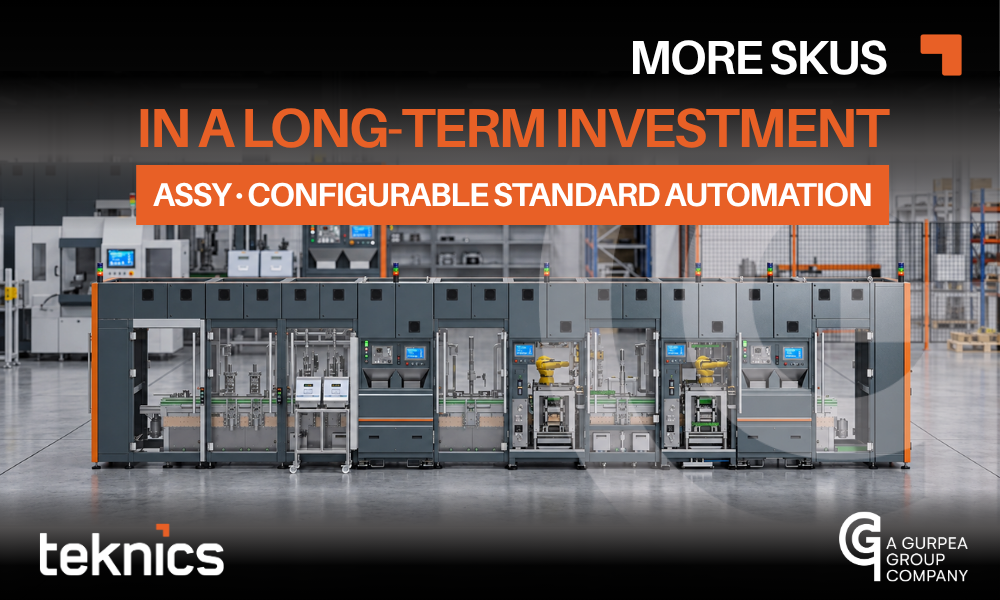
ASSY addresses both challenges in the automation architecture itself. It starts with a standard, pre-engineered and tested foundation—approximately 80% of the solution—covering transport, feeding, handling, controls, and software. The remaining 20% is configured around each product’s specific processes. The goal is to run different variants on the line while keeping most of its technology useful for future applications.
Multi-variant production: adapting the process to the product
Producing multiple variants takes more than selecting a different recipe on an HMI. Depending on how the products differ, the line may need a different feeding method, part orientation check, gripper or tooling head, robot paths, or process station. When these elements are inseparable from a design dedicated to one part, each new variant can become a substantial engineering project.
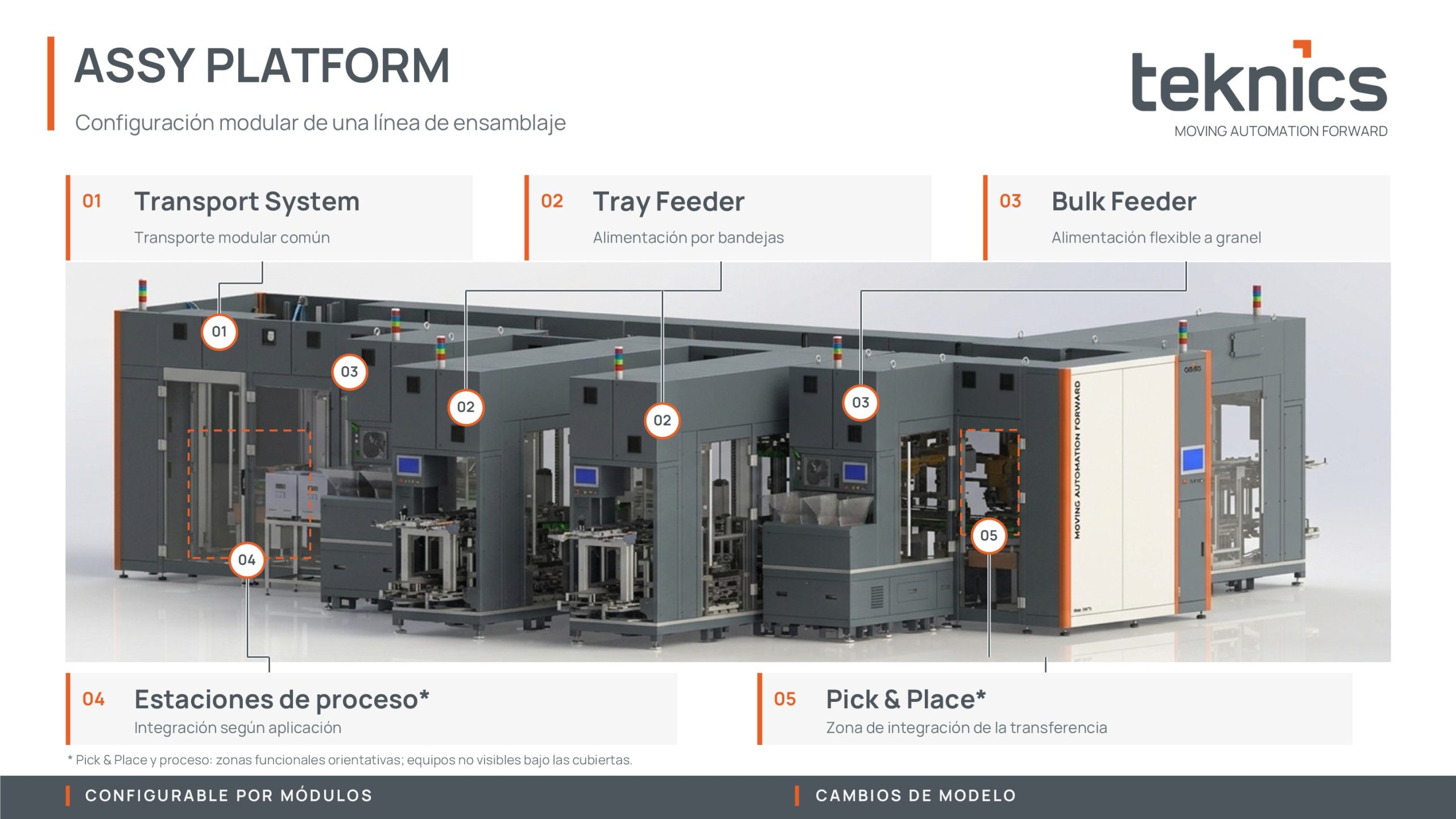
ASSY separates the common line architecture from product-specific elements. Its modular transport system links the stations; tray feeders and bulk feeders are configured for the way components are presented; and handling modules and process stations are adapted to the required operations. Common interfaces and a unified control architecture allow these elements to be integrated without redesigning the entire installation for every project.
This modular structure supports changeovers and the addition of new variants, including variants belonging to different products. It also makes it possible to design configurations that process multiple variants at the same time, provided the material flow, stations, and required throughput are engineered accordingly. As a reference, the transport module accommodates products up to 200 mm and 600 g[AB1] ; (other characteristics may be considered as the object of study) final capabilities depend on the line configuration and must be validated for each application.
For manufacturers, this flexibility can make shorter production runs and production closer to actual demand practical, reducing the need for large batches solely to justify changeover time. If a company needs to distribute manufacturing across several plants, a common architecture also makes it easier to configure comparable solutions for different locations, tailored to local production and delivery requirements.
Long-term ROI: an investment that outlasts the producto
ASSY’s architecture is designed to retain and reconfigure up to 80% of the machine for successive products. The investment can therefore continue to generate returns even after the original variant is discontinued.
The design approach allows up to 80% of the design—the standardized portion—to be repurposed for other applications, while fixtures, grippers, tooling heads, or product-specific stations are adapted to the new process. When the original variant reaches the end of its life, the line does not necessarily have to follow.
This extends the period over which the investment can be recovered: the installed foundation can create value across successive product families. The portion that can be reused will vary by application. It depends on how the new product’s dimensions, weight, throughput, operations, and quality requirements compare with the installed configuration.
Modularity also allows investment to be phased. A solution can start with the stations needed for current production and later expand with additional feeding, inspection, assembly, or testing modules. Capacity and functionality can grow as demand and the process evolve.
Less development from scratch: shorter lead times, lower costs, and reduced technical risk
With a fully custom-built machine, a significant portion of the project schedule is spent designing and testing mechanical, electrical, and software solutions anew. ASSY reuses previously developed and tested modules, interfaces, technologies, and control logic. Its platform approach starts from a foundation representing approximately 80% of the project, allowing application-specific engineering to focus on the product and its process.
This reuse has three direct benefits:
- Shorter development time. The team can start from a defined architecture and focus its efforts on product trials, process integration, and validation of the final configuration. This can materially shorten the time to production.
- Lower recurring engineering costs. Transport, control, and handling elements do not have to be redesigned for each new application. Standardization also simplifies procurement, manufacturing, and assembly.
- Lower risk in the core technology. Proven modules and functions reduce the uncertainty involved in developing the entire technology from scratch. Validation can focus on what changes: the part, its feeding method, the process, throughput, and interactions between stations
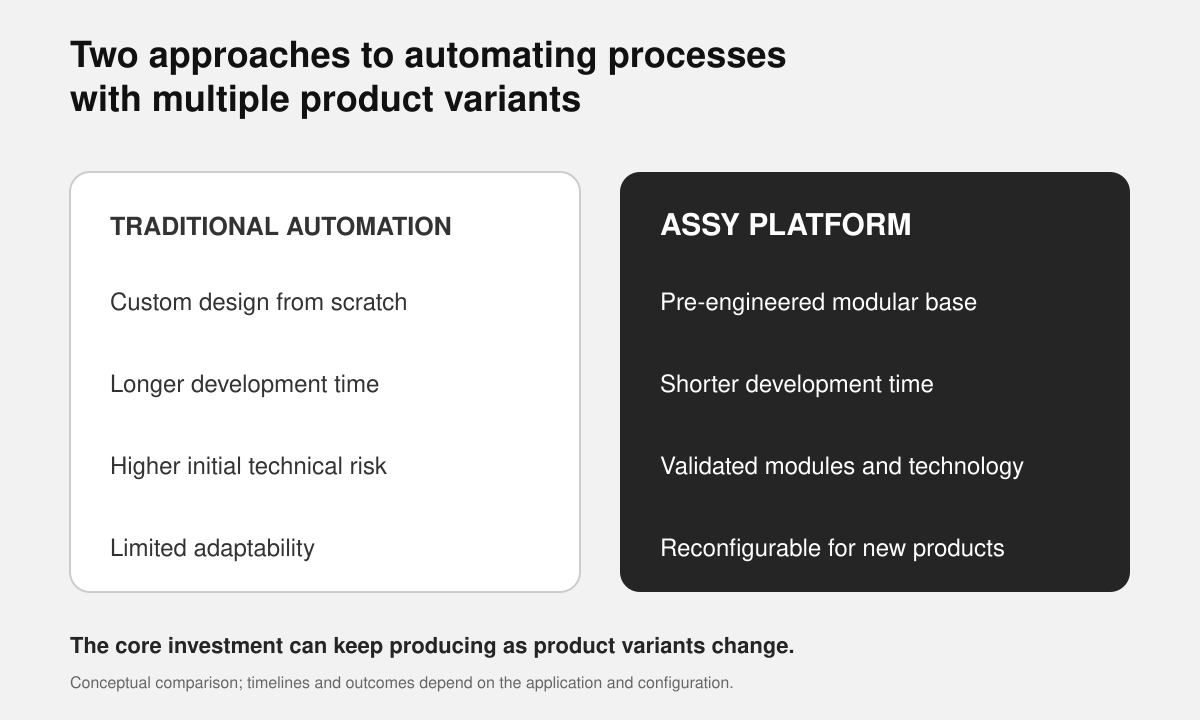
The result is a solution customized where the product demands it, built on a proven industrial foundation. Final throughput, changeovers, and flexible feeding performance are verified for each application.
Traceability and control for demanding processes
The common software architecture includes functions such as recipes, diagnostics, alarms, traceability, and preventive maintenance. These capabilities support consistent management of different variants and capture information about each stage of the process.
For regulated applications, the platform offers options such as ESD features and functions associated with 21 CFR Part 11. Their scope must be defined against the process and the customer’s validation requirements: a platform designed to support compliance does not replace assessment of the finished installation.